Showing posts with label Italian. Show all posts

Monday, 3 September 2007

La Casa Sperduta Nel Parco (1980) - Ruggero Deodato


It's a good job Ruggero Deodato made a name for himself, and established a reputation with Cannibal Holocaust because watching The House On The Edge Of The Park one could easily assume he's the Uwe Boll of the 1980s.

Starring David Hess from Wes Craven's Last House On The Left the parallels to that film do not end there, although in Deodato's film there are attempts at social commentary - albeit ones delivered with all the subtlety and nuance of a sledgehammer. The set-up is very close to Craven's film - people are tortured and abused at gun/knife-point before the captives turn on their captors to wreak bloody vengeance. The way this film never remotely approaches reality, is also a feature shared with the earlier work, only whereas Craven went for comedy Deodato goes for the plain ludicrous. A spoiler follows, but as i wouldn't recommend this film to anyone then i don't think it matters much (even so, if you might watch the film just skip to the next paragraph). The most ludicrous part of the film has to be the reason for it all - after all the killing and hurting we find out that it was all set up by one of the rich characters as a way of getting his own back on the guy who raped his sister; at this point you have to wonder why his friends agreed to be humiliated, raped and abused just so he could kill a guy none of them have ever met.

Like I've said above, the film is dire. Not even dire, but truly, abysmally atrocious. The lighting doesn't even match up from one shot to the next, never mind the play fighting that passes for violence or the dumbest scream in film history. Then there's the dialogue, the flow of the plot etc etc nothing makes sense, nothing is even barely believable. There's suspension of disbelief with films, then there's stuff that's so bad you just have to laugh at it, this is such a case. Thankfully however, being in the UK i saw the film after it had been cut by about 11 minutes - i for one am glad i didn't have to endure another 11 minutes of this crap.

3/10

Monday, 2 July 2007

L'Amico Di Famiglia (2006) - Paolo Sorrentino


In Family Friend, a wonderful recent Italian film Giacomo Rizzo plays Geremia De Geremei. Geremia is an old man, a tailor with a rather repulsive appearance who lives in a run-down apartment with his ageing sickly mother. He seems nice - people come to him for advice, money help and lots of people seem to like him. The poor old guy couldn't harm a fly, the moment you see him you want to put your arm round the quaint old fella and tell him everything is going to be alright (though you'd have to say it in Italian as he doesn't speak English). This impression lasts for about 15 minutes or so, maybe less, before it's revealed he's a lone shark who charges 100% interest on all monies lent. But what can and old man like this do if someone doesn't pay? Well he employs some rather burly twins to get the money, or something of equal value out of his customers. He's "a friend of the family" to everyone because no one wants to admit who he really is to others, or that they need his help. The film itself revolves largely around a father who can't afford his daughter's wedding, so he goes to Geremia to get the money for the wedding. Soon after the money has been lent, Geremia gets an offer from a businessman who needs a million Euros (that means 2 million repaid to Geremia - enough to set him up for life). Between the businessman, Geremia, the father and the gorgeous bride-to-be who will do anything to lower her father's repayments things get messy very quickly for all involved; all the while Geremia's one true friend in the world - a man with a penchant for line dancing and country music with a dream of moving to the US, offers him a friendly shoulder to rest on and some sound advice.


This wonderfully shot film, captured largely in dark orange tones that bring a sense of Mediterranean warmth with a suspicious edge to the frame, seems to be all about friendship, and what constitutes "real" friendship. Geremia has lots of 'friends', but like the dealer in Patrice Leconte's My Best Friend they are only in actuality business acquaintances. People respect Geremia because they fear him, and no matter how nice he tries to be to them they will always resent hi and the power he holds over them - even if he will never understand this because of his delusion that he is liked by these people. Why he doesn't seem to spend any of the money he makes (he keeps it all in a safety deposit box), and whether he was a loner before he was a lone shark aren't fully explained. It seems to be down to a very conservative, prudent outlook on life as well as his domineering mother who rules his life from her bed and his absent father who brought him up to be a lone shark. His only real friend might not be his country music-loving accomplice, but 'The Pirate' - a competing loan shark who may or may not exist, but in Geremia's world he certainly exists, and is probably the only person who can truly understand Geremia's situation.


The acting is as wonderful as the cinematography, Giacomo Rizzo is perfect in the lead while Laura Chiatti exudes sultry European sex appeal from every pore of her skin (even when her dancing leaves a little to be desired we still [i]want[/i] her as much as Geremia does). The editing of the music, the production design... it all comes together cleanly and crisply to elucidate a very unique vision of a seedier side to contemporary Italian existence outside of the major cities. In the end not all is answered, though nor should it be for this film - as it stands - is [i]very[/i] good and in the first 30 minutes or so, touches on genuine greatness where it an irresistible sense of power is attained. Let down only slightly by the con story that comes to the fore in the film's ending, the emotional complexity involved in trying to de-construct the film's protagonists is something not seen that often in cinema these days. Sorrentino refuses to paint a landscape of good guys and bad guys, he refuses to explain why nice people do bad things and he refuses (for the most-part) to give into stereotype and cliché (there is one wonderful scene in which we think Geremia is going to sexually assault a client, before it turns out that is not what he is after at all). A brilliant theatrical experience; a film i will probably try to revisit when it comes out on dvd.

7 leaning towards 8/10

Friday, 2 February 2007

L'Avventura (1960) - Michelangelo Antonioni


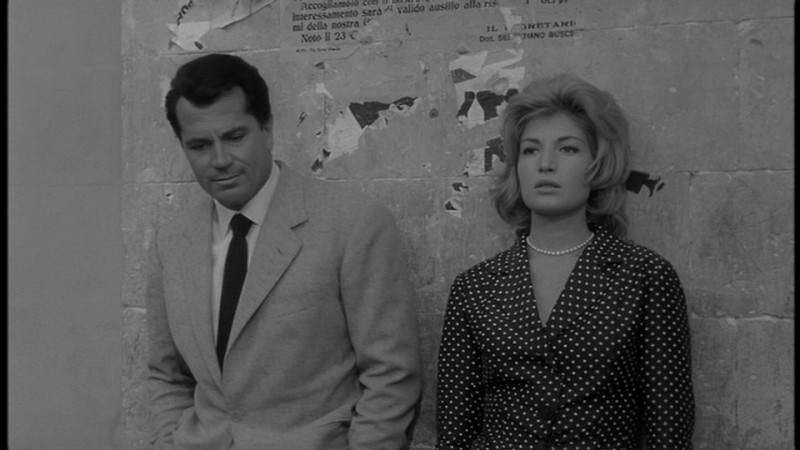
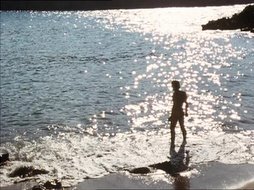
In this wonderful 60s film from Italian filmmaker Michelangelo Antonioni, a girl going missing on an island sparks a journey, across Italy in one sense physical, and in a far more meaningful sense - emotional that will leave its protagonists changed forever. Much has been written about the film already - including an excellent critique in Senses Of Cinema and an interesting review on Roger Ebert's site, so really i feel very much like i'm going over old ground here.

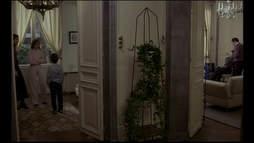
The title's ambiguity, translating both as The Adventure and The Fling is symptomatic really of the whole film's approach to narrative. There's barely a single shot in the film that's not executed to convey a variety of meanings and nuances - from the ever diminishing size of the key players in relation to their surroundings, to the use of deep focus photography to physically display the emtional distance between those characters. The lead couple - Claudio and Sandro believe, for a while that they have found love in each other's arms in the absense of the missing Anna (Sandro's girlfriend) but we, the audience never really believe this. Antonioni makes sure that through the way their scenes are staged the couple are rarely on the same level - either depthwsie or emotionally. They have a relationship, but it is one born of lusts of the flesh, a 'sick Eros' to paraphrase the director's own words. Through this central relationship, its emotional turbulence and voids, the facade of love the protagonists create, the director is able to slyly but assuredly pull apart what he saw as false moral fabric in 60s society. The way in which moral standards had not changed in line withs scientific ones by the late 50s seems to have angered Antonioni and, being a filmmaker, he was able to exorcise these false beliefs onscreen.

At every opportunity he sucks any possible emotion out of the screen, often leaving his characters set against a bleak empty background or in environments that makes them relative dwarves - large rooms either totally devoid of decoration or ornately addorned to the point of perversion (making up for in style, what the place lacks in feeling). Claudia and Sandro rarely stand next to each other, instead they are always apart - one close to the camera with the other set some way into the recessive background, trying futilely to reach out to their partner. With this total dearth of emotion in the frame, balanced by its own unique compositional efficiency and aperture artistry one can't really feel sympathy towards the couple; indeed empathy is probably the last thing Antonioni wants from his audience here. It's far more challenging for the film maker and viewer alike for the film to reflect on its audience and, more impoortantly, to challenge that audience's preconceptions.

And challenging preconceptions is what this film is all about. Fellini did it rather stylishly in La Dolce Vita , exposing bourgoise decadence for the hollow sham it really is but here Antonioni takes this a step further. Whereas in La Dolce Vita there are moments from which sollace can be sought along with a degree of hope there is none in L'Avventura. The only emotion that can really be directed towards the protagonists is that of pity; disdain may be too strong but the total lack of self-awareness on the part of the couple is, for the most part, astounding as they chose to cling to what they believe is love when anyone around them can see they're merely engaging in a selfish self-satisfactory carnal ballet. Come the end, in the film's closing shot, after Sandro has shown his contempt for idealistic youth and given into his libido one time too many, all that is left in their final embrace is mutual pity. He knows what he has become, how his social comfort has robbed him of his emotional counterpart and she - she finally sees herself as the pathetic vacume of emotion she has become. Looking desperately for love where there is none to be found, clinging ont even the merest fragment of hope no matter how unrealistic or short-lived that piece may be.

An irrefutably beautiful film, pervaded from the outset by bleak melancholy this film pities the people within it and the society that produced it but it does not scoren them. If Antonioni was to get what he wants we would learn from their mistakes, move on in the world and adjust the moral boundaries to more reliastic contemporary ones and ironically, hopefully, not fall inot the trap of total emotional desolation as the protagonists have done. Every line has meaning, every shot is a painting that could be hung on the wall, on a remote Italian isle Antonioni through an undramatic, emotional void has carved out his very own timeless masterpiece.

Roger Ebert's review
Senses Of Cinema article