Showing posts with label 1980s. Show all posts

Thursday, 1 November 2007

Frantic (1988) - Roman Polanski


Roman Polanski
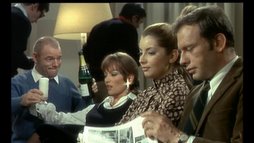
's Hitchcock homage, Frantic, was a far better experience than i'd bargained on. Harrison Ford plays the American bureaucrat out of his depth in a very mono-linguistic Paris. His wife scarpers while he's cleaning his nether regions in the shower beginning the film's main plot line - the search for his wife. The film could just as well been called Frustrated because he runs into dead-ends wherever he turns. At first, it seemed the film was making fun of - or at least highlighting - the pitfalls of cultural/linguistic ignorance in a foreign land; it's ok while everything's fine but as soon as things go array things get very difficult very quickly. However, this taut first half with minimal action and maximum notching-up of palpable tension gives way in the second half first to a plot involving drug smuggling, then finally to international nuclear espionage and a showdown on the Seine.


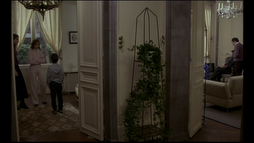
Beyond the fisticuffs, a naked Ford receiving a roundhouse kick to the face, characters scrambling over rooftops and spies in car chases there's much more to the film's construction. Polanski and cinematographer, Sobocinski, achieve countless shots that are simply brilliant in their simplicity as much as the attention to detail. The frame is so often broken up with verticals (doorways, windows etc) into at least 2, if not 3, distinct sections of action. Polanski compounds this with an incredible use of recessive depth which leaves the extreme background out of focus but ever-present. The colour photography, set and costume design like so many movies of its time looks routed in the 80s but this isn't necessarily such a bad thing. The relative dullness, the low contrast and saturation of the photography, allow the plot's tension and excitement to come to the fore rather than distract from it.


Ford excels in the lead in a role more akin to Jack Ryan than to Mr Jones, while the supporting cast do rather well with their own limited characters. All in all an entertaining, well-paced thriller that never outstays its welcome.


7/10

Monday, 3 September 2007

La Casa Sperduta Nel Parco (1980) - Ruggero Deodato


It's a good job Ruggero Deodato made a name for himself, and established a reputation with Cannibal Holocaust because watching The House On The Edge Of The Park one could easily assume he's the Uwe Boll of the 1980s.

Starring David Hess from Wes Craven's Last House On The Left the parallels to that film do not end there, although in Deodato's film there are attempts at social commentary - albeit ones delivered with all the subtlety and nuance of a sledgehammer. The set-up is very close to Craven's film - people are tortured and abused at gun/knife-point before the captives turn on their captors to wreak bloody vengeance. The way this film never remotely approaches reality, is also a feature shared with the earlier work, only whereas Craven went for comedy Deodato goes for the plain ludicrous. A spoiler follows, but as i wouldn't recommend this film to anyone then i don't think it matters much (even so, if you might watch the film just skip to the next paragraph). The most ludicrous part of the film has to be the reason for it all - after all the killing and hurting we find out that it was all set up by one of the rich characters as a way of getting his own back on the guy who raped his sister; at this point you have to wonder why his friends agreed to be humiliated, raped and abused just so he could kill a guy none of them have ever met.

Like I've said above, the film is dire. Not even dire, but truly, abysmally atrocious. The lighting doesn't even match up from one shot to the next, never mind the play fighting that passes for violence or the dumbest scream in film history. Then there's the dialogue, the flow of the plot etc etc nothing makes sense, nothing is even barely believable. There's suspension of disbelief with films, then there's stuff that's so bad you just have to laugh at it, this is such a case. Thankfully however, being in the UK i saw the film after it had been cut by about 11 minutes - i for one am glad i didn't have to endure another 11 minutes of this crap.

3/10

Tuesday, 13 February 2007

Idi i smotri (1985) - Elem Klimov


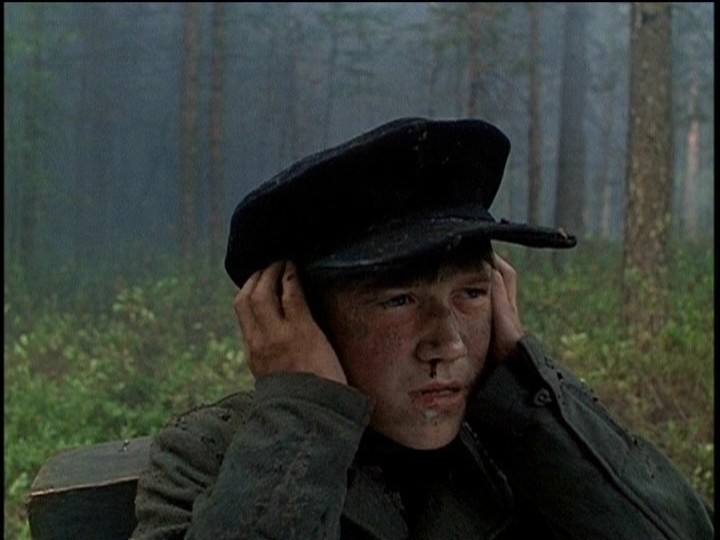
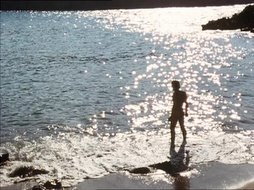
Come And See is without doubt, one of the great anti-war films. Initially i thought it might be similar to Tarkovsky's Ivan's Childhood but from the opening scene with the two boys digging on the beach for guns as a plane drones overhead, it becomes abundantly clear this is a different beast entirely.

Aleksei Kravchenko is an endearing in the lead role early in the film as his anguish, insanity and total mental shattering is gutwrenching come the conclusion. Just aboy who finds himself fighting alongside his countrymen in a war he probably doesn't fully understand, with no training and never having any objectives spelled out to him you have to wonder what hope he has realistically. The introduction therefore of Glasha (Olga Mironova) is, i think meant to represent some kind of hope as he finally meets someone of a similar age with whom he thinks he can find some sense in the chaos of warfare. Any hope is quickly disbanded when the bombs [and paratroopers] drop into thier forest and the bullets starting pinging off the tree bark around them. From the woodland scene onwards the stead descent of the characters into their own for of hell is as emotional as it is well-measured by the director.

It would be easy for the camera to focus on Florya's dead family, i can see many american directors chosing to exploit the scene of dead children to tug at the audience's heartstrings, but Klimov is clearly better than that - chosing instead to witness, up close the horror that is going on inside Florya's mind. Deaf from shell shock (and inevitably suffering from PTS) the trawl through across the bog to the island, during which Florya clearly starts losing his grip on reality is a masterclass in filming psychological breakdown. Initially we have some hope that he may get to his family - dashed by the shot of the dead bodies - then further compounded by the relentless walk into the bog sinking ever deeper and closer to death. The score at this point (by Oleg Yanchenko) descends into a truly horrifying, disturbing pit of dissonance, chords and keys crashing into each other with evermore ferocity as the girl realises she might die in the bog with the boy (who is quite clearly in the process of a mental breakdown). Out of tragedy, Klimov takes the film into the perversity of war with the strange effigy those on the island have erected of a German officer, a figure against which the bitter can direct their hatred. With the boy being sent back out again, this time in order to get food, the futility of the war and its inescapability really start to be hammered home. As the cow dies, even Florya is clearly wondering what the point of it all is, if everyone around him is being killed or left behind he seems almost resigned to death.

Going into the final section of the film, having witnessed the explosiveness of war, the threat and the psychological damage it can do one's left wondering what the film could have in store for a climax. The scene in the village is oe of the most difficult scenes i've watched in a war film, the whole series of events unfolding with an extremely depressing senses of the inevitable and shot at a slightly dislocated distance by Klimov so although we feel like we're actually there witnessing the horror, the audience also knows there is nothing that can stop it. The offer of letting the adults go without the children is a cruel twist of the blade, as is the apparent pleasure the troops take in pouring ammunitio into the building, relishing every magazine and grenade explosion. Having emotionally, visually, cinematically peaked with the massacre the end can't - or shouldn't be able to top it. In one sense it does, indeed the final shots of history in reverse as a photo of HItler is fired at have been seen by some as the best shots of the film. My own personal take on this sequence is that the boy, out of depression, resentment, anger, a whoel swathe of emotion is trying to reach a catharsis by firing his weapon into an effigy of the figure that he has been told is to blame for the war. All the horrors of the boy's life are linked to the war, so by shooting into the picture he can metaphorically, symoblically release the tension inside him against a figure of pure hatred. The way the sequence also finishes on the child portrait - a time when the boy was still innocent, unjaded by the world around him also seems to pose as some kind of hope for the audience: though not an overtly positive finish this is clearly as close to a happy ending as Klimov is willing to go. The final shot is picturesque, pure, hopeful and nice, in some way counterbalancing the nihilism of what has gone before in the film; at the very least it is the best image of the film that one could remember afterwards (and far more prefereable to some of the film's brutality).

I do have one overriding reservation though. I know that 600+ villages were destroyed by the German army, and i know a lot of Russian civilians were needlessly killed but - the film seems to go out of its way to demonise the german characters. From the sacrilegious SS officer effigy to the col-hearted way the germans relish the slaughter of peasants, there is nothing to say the Russians are any more than victims. No mention of the horrors purpotrated by the advancing Russian army, and in the backwards sequence where we see villages burning - a lot of those villages were probably burned down during the period of Russian retreat when a "scorched earth" policy was operated to prevent the Germans getting use out of the conquered land. Made in 1985 i guess the producers couldn't make a film too critical of the Russian army during WW2 but without this criticism the film struck me as far more anti-german than an anti-conflict/anti-warfare piece. 9/10

Thursday, 8 February 2007

The Last Of England (1988) - Derek Jarman


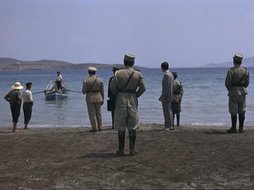
Not having any idea of what Derek Jarman's films are like before diving headfirst into this particular title is as much of a hindrance as an advantage. With no preconceptions (except those garnered from the reviews on IMDB) i didn't know what to expect, having never really seen a truly abstract film save perhaps Un Chien Andalou, but a total absence of a story is all this film has in common with Bunuel's surreal short.

From the outset it becomes abundantly clear that this is Jarman's personal film, an exposé if you will of his bitterness towards late '80s UK culture and society. As we see him working at his Bankside studio there's something tense in the scene, but it's not clear exactly what or why. But before the audience has time to work out where this film is or who the man at the desk is (and where he is) the didactic assault on the senses - aural, visual, emotional, political begins in earnest. A snapped shot of a person holding a flare, a man injecting heroin, masked men with guns. Shots cut together at a rate you might expect from Michael Winterbottom, but far from the contemporary dirctor's haphazrd scattershot approach to editing Jarman's constrcut seems to have far more in comon with soviet nontage cinema. We see the artist, then we see a boy masturbating over a Caravaggio painting, we see a flare illuminating the darkness - there is not one image that is placed at random into the montage; everything is placed together because that's the best way to get across the message. But this then begs the question - what is his message?

The message, the point or focus of Jarman's cinematic barrage appears to me to be a countercultural political polemic. In the 1970s political syndicalims became rife amongst the working classes of a Labour britain; under Thatcher the mines were shut down (amid violent protests) and the army got tough in Northern Ireland (Human rights cases over internment dragged on for years afterwards). Her government, under the 'Iron Lady' was one of solidity, of national strength, in the case of the Falklands conflict a manipulated patriotism. Jarman seeing all this also sees a loss of traditional morality, a loss of heritage and i think, Britishness. Society, in Jarman's eyes emerged at the end of the 1980s fragmented with the working classes wholly out of touch with the middle class - so his film is just as fragmented. Perversly in this dystopic industrial wasteland a man injecting heroin, a man getting shot on a rooftop by masked gunmen and a tramp scavaging for food in a scrapheap does not seem at al out of place. Indeed it's these social pervsersions that seem to define the environment for Jarman, the scariest thought of all however is that none of these nameless characters who fliter in and out of the film are fictional - in 1988 you could probably go to a scrapheap and find the tramp, or go to a part of Belfast where a ritual execution was taking place and in London heroin was soon to make way for the deluge of ecstasy in the yuppy 90s and later cocaine.

There does however seem to be some hope, some light in the darkness, held aloft by a facless person lighting the path if not to righteousness then at least to a possibility of a better future. It's no accident that the final shot is of a man holding a flare in a boat being rowed away by people dressed like KKK members. What came to mind watching this scene was the famous headline in The Sun which read: "Will the last person to leave please turn off the light". Whetehr this a deliberate reference or whether i'm reading too much into it the repeated motif of this person with a flare that crops up amidst all other sorts of chaos is an interesting one that clearly has purpose, even if that purpose is not easily fathomable. The same can be said of the marriage scene, that Jarman pays an awful lot of attention to with his camera. A man and woman get married in a dirty derelict building, falling apart and covered in crap, surrounded by various unusal aspects of society - a crossdresser and a dwarf are the more memorable. Following the ceremony we then see the woman outside with a large fire burning nearbye. I sort of expected her to go into a political speech like Eve in Godard's Sympathy For The Devil but she doesn't - jarman's far more interested on her body language that resmebles, for me, a kind of mournful despair. This should be the happiest day of her live, but under Jarman's subversion it becomes a fascinating bastardisation of classical traditions, the purity of her white dress somehow remaining untainted by the filth and desolation around her like some sort of innocent virginal survivor of a holocaust.

Photographically, the film is just as planned, precise and made to be controversial. In a world where Hollywood spends millions on big budget 35mm movies Jarman works from a small bankside studio shooting on an 8mm camera splicing in 40 year old home video footage his parents shot. The lighting is as bizarrely striking as it is shoddy. The vibrant colours arent fully exploited because of the amateur equipment, but it's also this amateurness in the cinematography that makes everything so much more powerful. Light and colour merge into the environment changing everything onscreen in a way that would never happen in a the highly controlled environment of a Hollywood studio. Then over this we get a soundtrack with as much avriety as anything else in the film. Pomp And Circumstance becomes a symbol of faux nationalism, an insincere facade of pride that hides an underlying disilusion and apathy - a complete contrast to the usual outpouring of zeal it's accompanied by at The Proms. Simon Fisher-Turner's own unique, highly original score is just as effective in evoking the kind of feeling Jarman intended as Philip Glass' score was for Koyanisquatsi (a film that also shares the fragmented narrative structure although with more coherence than this film). In fact, the best way i can describe what watching the film is like is to say it's Koyanisquatsi meets Tarnation with The Rocky Horror Picture Show and Who Dares Wins thrown in for good measure.

An impossible film to get your head round, with an overt style many will label as arty or pretentious, but one that has unrivalled passion at it's core. A smack in the face for British conservatism and modernity that uses the very tools of modenity to evoke a certian nostalgia for the preceeding traditions, morals, society as a whole. Watching this film, then turning on the news almost had me packing my bags and emigrating.

10/10

Thursday, 25 January 2007

Santa Sangre (1989) - Alejandro Jodorowsky


This film has been my introduction to the cinema of Chilean-born director, Alejandro Jodorowski - and what a cinema it is! A cornucopia of the fantastically surreal, horrific halucinations and littered with moments of touching poignancy - indeed, something for every fan of film.

Fenix (played by the director's son) is in some kind of hospital. In flashback we are shown how, being brought up in a travelling circus, he was traumatised by the sight of his womanising father (caught in flagrante) chopping off his mother's arms before committing suicide slitting his own throat. After a night out on the town with a collection of other disabled patients Fenix escapes the hospital to reform a travelling troupe with his deformed mother. Gathering together the old crew the show takes off but, as a deaf mute from his past seeks him out having escaped her whore captor, Fenix finds himself murdering the women around him on behalf of his mother. With the entrance of the mute in the film's climax and the realisation of his love for her the symbiosis between mother and son faces its toughest challenge, a challenge that one or both of them might not survive.

The filming started when Alejandro was commissioned to make a film based on real-life Mexican criminal Gregorio Cárdenas; yet from this inauspicious beginning, under the director's guidance a truly resplendent surreal horror feature referencing a broad scope of Mexican cinema has been sculpted. Personally speaking, I am practically ignorant of the direct references to Mexican cinema in this film as i have seen very few films from that country, however that is not to say other cinematic comparisons cannot be drawn; in many ways this film struck me as very European (perhaps it is also worthy to note here that a large amount of funding came from Italy).

Fenix's relationship with his mother, letting his hands become hers doing her bidding, evokes memories of the twins in Cronenberg's Dead Ringers where one of the brothers sleeps with the women of the other. Then there's the vengeance itself stemming it would seem from some sort of perverse incestual feeling between the mother and her son, using her son's limbs to enact her jealousy against those young licentious women whose bodies entice her precious son away from her - much in the same way The Birds attack Tippi Hedren's character in Hitchock's thriller. The cinematography within the film is of the consistent aesthetic vibrancy you'd expect from Luciano Tovoli in a Dario Argento horror (for example Suspiria) and the music, well it's glorious but in a way like i've found in no other movie so far. Combining all these ingredients [and more] in the hands of Jodorowsky has produced something akin to a Felliniesque horror, a Mexican Satyricon with lashings of gore if you will. Unique in it's vision, extraordinary in execution the film comes across like Passolini on acid.

Don't get me wrong though - this acidic virtuosity, grandiose as it is, remains underpinned by a seriously well-writen screenplay with solid, real characters you can care for and believe in. The startling imagery, sometimes prone to flights of exotic fancy, is not the heart and soul of the film - rather an awesome dressing that tops off a sumptuous cinematic feast that deftly [and at times shockingly] combines compelling performances with heightened moments of melodrama and surrealism. When the violently ecstatic gore comes it's in floods, but not distractingly so - if anything these extreme death scenes display a certain quality of endearment towards the films [i assume] it is homaging. And then, to tie the dizzying narrative together we have religious iconography, such as Fenix grappling with a snake, a Jesus-figure surrounded by chickens and various animals lapping up human blood.

Totally absorbing from start to finish, Alejandro still has one card left to play - challenging the viewer's perception of almost everything he has just witnessed - that he deals right at the last moment in the film's final scene. Did we really just see what we thought we saw? This is not some lame clichéd plot twist that will aggrieve, rather it's a challenge on the audience, an avenue via which one can re-examine the film from a new perspective gaining perhaps a fresh insight into the movie's characters that now maintain a wholy different resonance the second time round.

The film, in short, is a must-see. 9/10

Wednesday, 17 January 2007

Bez Konca (1985) - Krzysztof Kieslowski


Kieslowski, probably Poland's most important filmmaker alongside Andrzej Wajda, started his career fresh out of film school making shot documentaries and industrial information films. From the early criticial (at leats in the film school he graduated from) success of Urzad (1966) through to the late 70s Krxystof had een content making these films for money (so in the future he could risk investment in unprofitable but more artistic feature films). However, in the late 70s/early 80s, around the time Talking Heads and Camera Buff were released grander artistic ambitions started displaying themselves in the Pole's work. Thus, in 1985 Kieslowski took one further step away from his early documentary style into the realm of metaphysical cinema with the critically acclaimed No End.

Filmed by his long time collaborator (and fellow film school graduate) Jacek Petrycki with haunting music from the great Zbigniew Preisner, No End is a family drama wrapped in political tension wrapped in melancholy. In the opening scene we find out that the man who we initially believe to be the protagonist, Antek (played calmly by Jerzy Radziwilowicz) is in fact already dead. He's dead yet he stays to watch over his widow Urszula (played by Grazyna Szapolowska who had recently appeared as Livia in Károly Makk's Hungarian success, Egymásra nézve [1982]) and his son Jacek (Krzysztof Krzeminski). In the wake of the recent death of her husband Urszula has trouble coping, a fact not hepled when the wife of one of her husband's clients comes forward looking for a file. Urszula can't give the woman the file but suggests the soon-to-be retired lawyer Mieczyslaw Labrador (Aleksander Bardini), who was her husband's mentor, should take the case - he agrees as it is to be his final swan song. As the case progresses the corruptability of Polish justice [as it then was] and the presures of living under the socialist system in which strikes are banned come to the fore; meanwhile Urzula tries everything from sleeping with an Englishman to hypnotism (by a dubious practitioner who may or may not have taken advantage of her) in order to overcome her relentless grief. In the end, through the bleakness there is a ray of hope for the mother and her son although in many respects it is not a happy one.

The film has as many strengths as it does weaknesses. Critics have said, much to the disdain of the director, that the film is actually two separate movies. Firstly the story of the widow dealing with her grief, and secondly the political prisoner fighting an injust sytem with the help of corrupt officials, a battle which will shatter many youthful ideals of those involved. For me however, the film is a conflagratio of these issues, it exists at the point where the personal meets the national - where man (or in this case, woman) meets society. Urzula's problems can be seen as a metaphor for Polish society struggling to move on under the weight of socialism to a new future leaving the pre-war past behind. But this in itself is an oversimplification of matters, Kieslowski is dealing here with real people with real emotions, with deep souls who do not always make the best judgements available and it is this complexity of juxtaposition between the people and the metaphor that makes this work so enthralling; complexity which reaches a dramatic pinnacle in the scene between Urzula and the Englishman that comes across as perversly erotic, both utterly fascinating and morally reprehensible at the same time. Testament indeed to the acting talents of Grazyna Szapolowska.

This narrative complexity is just one ingredient though, in a far greater whole. Preisner's deceptively simplistic music, utilising simple chord patterns and melodies in a minor key to produce a truly sadening ambience, combines effervescently with Petrycki's sublime camerawork to produce some truly unforgettable, poweful cinematic moments that indellibly etch themselves into the viwer's brain forever. From an aesthetic point of view the film is a true feast of technique and artistry. With a heavy fly-on-the-wall documentary style we, the audience, become totally and irreversibly enmeshed in the lives of the characters until it is impossible to resist the sorrow and joy they feel. Sitting comfortably in Kieslowski's early oevre there are many times however when the true transitional quality of this picture fills the frame, when it is clear that a grander ambition lies behind it to portray something not only human but in many ways metacinemtic, not least in the uplifting metaphysical denoument that has left so may viewers inexplicably unhappy. Maybe this ending leaves them unhappy precisely because it is so close to truth, refusing to pander to archetype and cliché there is only one way out for the protagonist n matter how much you will another solution to surface. It is true to say that not everything is tied up by the end, yet again though this shows the documentary routes of the filmmaker - that despite its more fanciful moments this films foundation lie firmly and irrevocably in beautiful, if melancholic reality.

A truly wonderful film, 8/10

Thursday, 4 January 2007

Querelle (1982) - Rainer Werner Fassbinder


The last film Rainer Werner Fassbinder directed before his tragic death from drugs - a film drenched in self-loathing, and homoeroticism.

The titular Querelle is a sailor who comes ashore in Brest, France to find his brother living a hedonistic lifestyle as the lover of the local bbrothel's madam. Through the film, through murder and capitulation Querelle questions himself constantly, searching for love and an identity. Tensest of all perhaps is his battle with his own homosexuality and the allure/power he has over other men as a result of his cherubic features.

The scorching oranges and reds of the photography imbue the film from start to finish with a raw, pasisonate erotic fervour matched only by the theatrical melodramatics of the cast given their bizarre rules, all taking place on some very shoddy sets. The aesthetic intensity of the film also carries over into the reflective pseudo-philosphical narration that lends the film a poetically lyrical feel, and a flowing structure that otherwise would be sorely missed - not least because of the sporadic use of title cards.

A visually striking film whose curiously hedonistic atmosphere seems to hide something more sentimental, something softer just beneath the surface that occasionally surfaces through rare glimpses of modest poignancy. Not Fassbinder's best film by any stretch of the imagination, but nonetheless an important one that lays bare many of his own personal daemons through the personae and events onscreen.

7/10