Showing posts with label french. Show all posts

Tuesday, 19 June 2007

Comédie de l'innocence (2000) - Raoul Ruiz


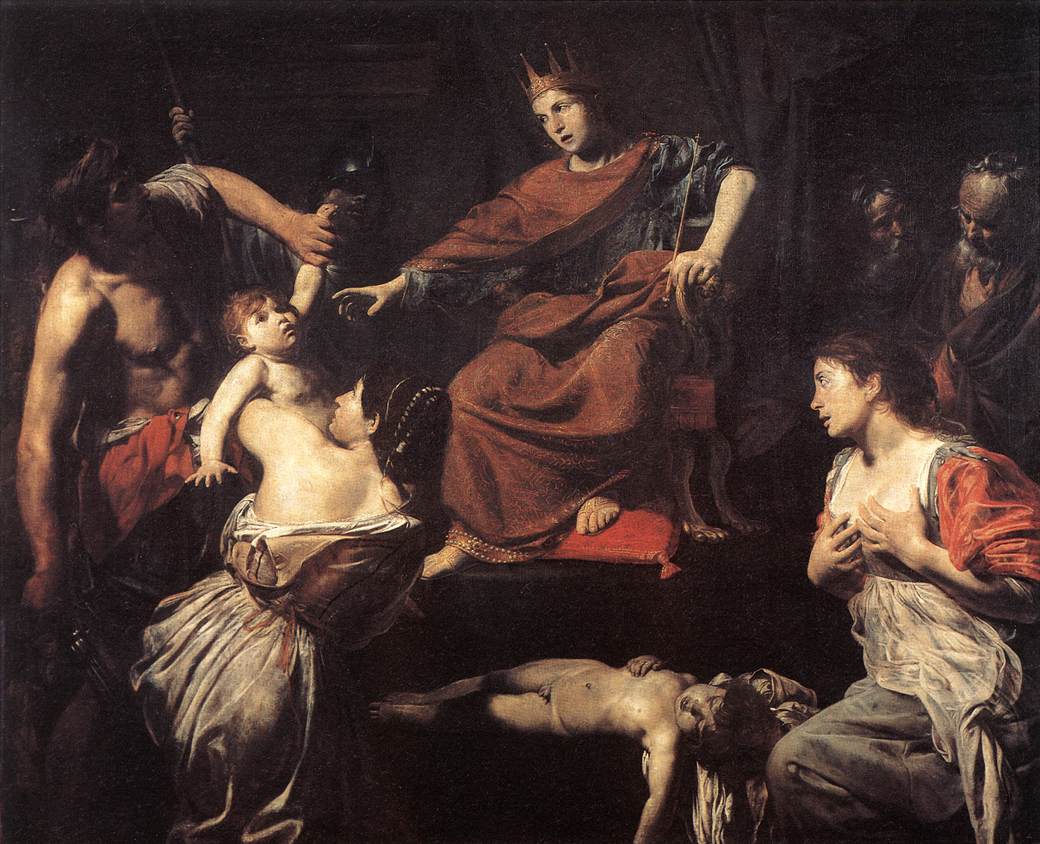
The Judgement Of Solomon: I Kings iii 16-28

Then came there two women, that were harlots, unto the king, and stood before him.
And the one woman said, O my lord, I and this woman dwell in one house; and I was delivered of a child with her in the house. And it came to pass the third day after that I was delivered, that this woman was delivered also: and we were together; there was no stranger with us in the house, save we two in the house. And this woman's child died in the night; because she overlaid it. And she arose at midnight, and took my son from beside me, while thine handmaid slept, and laid it in her bosom, and laid her dead child in my bosom. And when I rose in the morning to give my child suck, behold, it was dead: but when I had considered it in the morning, behold, it was not my son, which I did bear.
And the other woman said, Nay; but the living is my son, and the dead is thy son.
And this said, No; but the dead is thy son, and, the living is my son.
Thus they spake before the king.
Then said the king, The one saith, This is my son that liveth, and thy son is the dead and the other saith, Nay; but thy son is the dead, and my son is the living. And the king said, Bring me a sword.
And they brought a sword before the king.
And the king said, Divide the living child in two, and give half to the one, and half to the other.
Then spake the woman whose the living child was unto the king, for her bowels yearned upon her son, and she said, O my lord, give her the living child, and in no wise slay it.
But the other said, Let it be neither mine nor thine, but divide it.
Then the king answered and said, Give her the living child, and in no wise slay it she is the mother thereof.
And all Israel heard of the judgment which the king had judged; and they feared the king: for they saw that the wisdom of God was in him, to do judgement.


Antonio Machado: Is this the house where we cut innocents' throats?
No, here we just cut throats.


The Film:


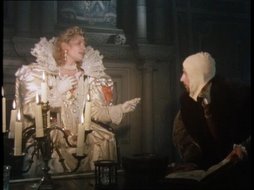
Ruiz's Comedy Of Innocence, based upon Massimo Bontempelli's novella Il Figlio Di Due Madri, quickly emerges as a riddle, wrapped in an enigma shrouded in mystery. What at first seems to be a fairly straight forward tale of mistaken identity soon becomes something far more dense, far more perceptive and - far more interesting. As the director has stated, the film's narrative and the events within that narrative have an explanation but that explanation doesn't actually explain anything. Throwing the audience's perceptions of reality is one thing, but to do so in quite the controlled manner demonstrated here by Ruiz really is something quite extraordinary indeed. So, where to start with analysing such a superb piece of film making?


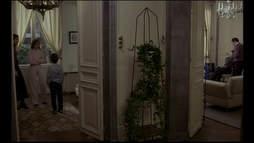
The story revolves around a comfortable bourgeois Parisian family, played by Isabelle Huppert, Charles Berling, Denis Podalydès and Nils Hugon - plus the nanny (Laure de Clermont-Tonnerre). This family enjoy their life surrounded by [mainly artistic] luxuries, Huppert is a theatrical designer who paints in her spare time and Podalydès is a businessman who spends a lot of his time travelling leaving his medical brother, Serge (Charles Berling) to look out for his family. Everything is going as per usual whe one day the young boy, Camille, starts behaving strangely. Strange behavious is not unusual for a 10 year old boy but Camille then claims that's not his name before taking his mother to a house in a part of Paris he's never visited before, claiming it to be his "real home" - then, we meet Isabella (Jeanne Balibar) who the boy claims is his real mother. Ariane (Huppert) invites Isabella to stay in their house while she figures out what is wrong with her son, hoping perhaps that medically-trained professional Serge might be able to cure whatever it is that is happening to him. During this time Camille has decided his name is in fact Paul - the name of Isabella's deceased son who also happened to be born on the same day as Camille, which raises the question for all involved, "Is Camille really Paul?". In the end a resolution of sorts, is reached although it still leaves many questions unanswered (almost certainly Ruiz's intention).


Perhaps the most interesting aspect of the film, is that it can be conceived of as a ghost story with no ghosts. Be it for Gallic traditional reasons, economic reasons or otherwise it is noted by the director on the Region 2 dvd that the French don't tend to make ghost films like some other countries do/have done. Camille has a friend, Alexandre, who may be imaginary, may be a ghost, or may actually exist in real life. Likewise, when we find out about the accident that supposedly killed Paul, there is enough left unsaid to suggest that there's a possibility that Camille could be Paul, in which case he would in effect be a living ghost - a boy who died but who is alive. The comfortable, expansive, bourgeois Parisian house in which most of the film takes place itself becomes a character in the film. Beyond the strange sounds there is a creepy, disturbing over-abundance of busts filling the mantelpieces and shelves of the interior, more than that however, as the film progresses the statues move to face in different directions.


It's easily missed at first but on watching the film again it's quite noticeable that between scenes they move to look towards people or objects in the house - the most obvious example of which is when one of the paintings hanging in the house inexplicably changes from a portrait to The Judgement Of Solomon; suddenly the statues in the room are all looking at the painting. There are other little things too - the way the camera pre-empts the movements of the characters as if the house knows what they are going to do, and then there are the strange sounds, sounds that don't match what is actually happening on-screen the most common of which is the rushing of water we hear when there is no water around.


Water, the ebb and flow of which, seems to form one of the central themes of the film. Be it the bizarre blue colours that afflicts some of the abstract images Camille films on his camera, or simply the way he holds his camera above the dinner table like a periscope rising from a submarine there is water running through this film. In one rather shocking scene the image itself warps and goes a blue tint as Camille invites his uncle to "come into the deep water" with him. It turns out there are quite literal reasons for this aquatic feel - the boy Paul drowned when he fell from a barge on The Seine, but beyond this water has always had connotations of femininity (see Polanski's Knife in The Water for some not-so-subtle sexual symbolism involving water) and this is a film that very much deals with concepts of femininity and womanhood.


The film is filled with shots of flowing water that both mirror the fluid nature of the plot's development and suggest or hint at the emotional turbulence that could come. One angle of the film is that maternity, or the maternal instinct at least is as dangerous when array as any other force in nature, likewise water can be safe but with certain currents and eddies people can quickly find themselves impossibly submerged without oxygen; it's easy to quickly lose your bearings underwater. All of these notions come to the fore towards the film's climax with an emotionally shattered, desperate Isabelle Huppert sat in her garden on a chair with Camille/Paul running around her with his camera: all we can hear is the sound of rushing water.


I think it is the maternal elements of the film, and the other human relationships within it that form the crux of the masterpiece. On the face of it you could look at the film and see that the boy is lonely, that his rich mother (Huppert) doesn't love him, that the nanny who is always hovering in the background is more of a mother to him than his real one and that his 'new' mother gives him the love and affection he has craved for so long. Life isn't that simple though, and nor is the film. The nanny is having an affair with Serge (the boy's uncle), when Isabella arrives on the scene it's not too long before she too tries to seduce Serge - is this trying to suggest the two women are very similar? Certainly the nanny seems to resent Isabella's presence as it seems to impede her own maternal instincts; the nanny always carries a doll of a little girl around with her - again suggesting maternal issues relating to childhood.


Indeed, a psychologist could watch the film and see the father abandoning his child to go on business, but with Serge fulfilling the father-figure role for the majority of the film that doesn't quite explain what's happening or why. Serge himself is interesting because while he's clearly an adult, he gets very angry when he sees Camille playing with his toy cars - he doesn't quite throw a childish tantrum but you can see one brewing in his eyes. Having said [above] that Huppert's character doesn't love her son enough that patently isn't true - her hurt both physically and emotionally as her child rejects her is palpable; few actors can do torment like Isabelle Huppert and in the film even she really excels herself. Does perhaps the boy Camille feel he's been abandoned by his parents, maybe because he spends all his time with the nanny and his father usually only talks when telling him off? It's unlikely as we see they do spend a reasonable amount of time together as a family and get on with each other as well as any family unit can be expected to.


It's this that really makes the film so brilliant in my mind - at first it's straight forward but the more you try to unravel the plot and the inter-relationships of the characters the more unfathomable it becomes. The way that Ruiz has thought through every aspect of the film-making process from the editing (there's a noticeable absence of shot/reverse shot cutting) to the sound (water, sound of footsteps etc) to the way each shot is framed beautifully with luxurious tracking and panning movements is simply a feast for any cinephile to behold, and it's all capped off with some incredible performances and, her, i ave to say the crème de la crème is Jeanne Balibar as the invasive but seemingly innocent Isabella. A uniquely fantastic film, instantly rewatchable.

9/10

Thursday, 19 April 2007

Les Amants réguliers (2005) - Philippe Garrel


There is another short clip from this film on youtube HERE

I'm not going to write much on this film, not much at all - i just felt i had to blog an entry on how, more than a film, Garrel's 180 minute mélange is an endurace test of the highest order. Seriously: people who make it through all three hours of this abysmal work in one sitting deserve some congratulations and - preferably - a medal.

Set in 1968 Paris it's really not clear what this film is actually about, who it's about, what they do, or why. Stuff happens - albeit sporadically - but as we never really get to know any of the characters it becomes impossible to care about any of the events occuring onscreen. I'm sure there are thick layers or visual metaphor and symbolism, and undoubtedly the film is filled with references to the nouvelle vague (even if the film's style itself seemed closer to Italian neo-realism) plus messages on the nature of artists and politics but for me it remains the embodiment of the arty, pretentious crap that puts so many people off foreig cinema.

There are many many better ways to spend three hours than watch the awful Regular Lovers.

My advice: watch Prima Della Rivoluzione or The Dreamers instead.

Wednesday, 7 March 2007

Les Biches (1968) - Claude Chabrol


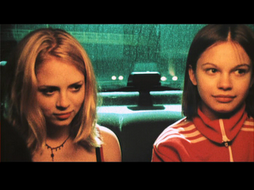
Chabrol's The Does follows the story of two women and the man who comes between them. Frédérique (Chabrol regular, Stéphane Audran) is a well-to-do Parisian who one day comes across this actractive woman drawing deer on the pavement (Jacqueline Sassard), a woman who only gives the name Why when questioned. The two quickly start up a relationship, barely days later moving into Frédérique's St Tropez home where her two acquaintances, Fernand Robèque and Jacques Riais, have alread settled into their comfortable riviera lifestyle. The relationship is complicated when firstly, Why falls in love with an attractive poker player (Paul Thomas played by Jean-Louis Trintignant) who she meets at a party, then furthermore when Frédérique steals him away to Paris for a few days. The film's dramatic focus in the final reel is on Why, her jealousy, hatred, sense of betrayal and the vengeance she decides to enact.


It becomes abundantly clear aearly on in the film that Chabrol is a master of creating his characters in 3 dimensions. Everything from the clothes they wear to the rooms the inhabit tells us aout who they are, not to mention the specific maneurisms and body language key to each charcter's unique personality. The comic relief for instance, Fernand and Jacques, are effeminate, garishly dressed with a ribald sense of humour to match. When they are sent to follow Why after the party they do so in the most unsubtle manner possible, with some funny results. Converesely Why heself is a creature of ice coolness. Her clothes are neat, usually drkly coloured, her hair rarely out of place and her makeup always impeccable. There's always a sense that there's something beneath her icy curface more sinister, darker, but we never know what that is exactly as it becomes evermore masked by the chic gallic sensuality she exudes from every pore - similar in many ways to that of an Emmanuelle Béart character - only without the apparent innocence of Béart. The same goes for Frédérique, who's smartly expensive designer clothes perpetuate her higher social status than those around her, the hunting trophies on the walls of her St Tropez home reflecting her predatory nature. A young femme fatale and a sexual predator, with a rather charming middle class businessman caught in the middle.


The characters, richly drawn as they are, are not quite so simple though - nor are the relationships that bind them. Frédérique and Why get very close surprisingly quickly, almost unnaturally so after their first encounter on the streets of Paris; similarly the way Why becomes attached to Paul seems almost too quick for her persona. It is this "unnaturalness" in the development of the relationships that, i think, reveals some of what is going on below the surface. You have to wonder pourquoi is this happening quite the way it does; what is motivating these people to coalesce. At first it would seem the two women are connected on a purely lustful basis, that being liberal 1960s women they want to explore each other's bodies as much as their souls. The seduction of Why would certainlys eem to be a sexual liason, if not physically enacted then at least in the atmosphere of their early scenes. But taking Why back to her home outside of Paris suggests a maternal element in the couple, an element that becomes more exagerrated in the matriarchical structure of the living arrangements in St Tropez. Once there it is clear Frédérique rules the roost, she commands the men she plays poker with when it is time to settle up and the two men who live with her are always unashamedly subservient to her, although it's never made clear exactly why they live with her. My assumption is that they are with her for the money, and that Why is there almost for the same reason.


Why never mentions a family, so there is certainly reciprocation of the maternal element on her part, but also it has to be remembered that she was selling drawings on the streets for money. She was clearly never comfortable economically, perhaps this new relationship offers financial as well as emotional reward? Given this proposition, some of what Why says takes ona slightly different meaning: when she says she is a virgin this, at first, seems like an emotional opening, a brutal honesty to demonstrate commitment - however now this could be the start of a honeytrap; it gives Frédérique a position of sexual authority through which she can exert control over the seemingly impressionable Why, which is probably playing right into Why's hands. Why's calculating manner becomes further apparent during the poker game, during which she uses her body language and raw sensuality to make Paul seduce her. Paul, of course, will believe it was him who made the first move but suring the scene it is Why who makes a point of grabbing his attention, and focuses all of her energies on him for the whole night. This suggestion of coldness, of cynical calculation could be overlooked if it weren't for the film's climax in which Why becomes a creature of pure cold calculation, that uses her charms to get her way in a manner until then one wouldn't have thought possible (or if thought possible, then thought would have been quickly dismissed).


This writing of characters and relationships would be the film's highlight, if it weren't for Chabrol's wonderful visual style, placing his characters in scenes and filming them in such as way as to make each shot seem at once perfectly natural, and the conception of a great artist. His tracking shots give the scenes fluidity whilst reminaing impressive on thier own technical merits, whilst the us of focus both shallow and occasionally - deep - allows him to let shots linger than other more impatient dirctors would be inclined. With Jean Rabier's expert cinematography, utilising the St Tropez light to its fullest, Chabrol is able to place his engaging drama amonst a series of splendid tabeau compositions, each wonderful in their own right and moreso when they flow together so eloquently. In Le Mépris Fritz Lang says of Cinemascope, "Oh, it wasn't meant for human beings. Just for snakes... and funerals.", a sentiment echoed in Chabrol style here. He doesn't shoot either snakes or funerals, but what he does do, to maximise the use of the widescreen frame, is have his characters sleeping or reclining through an awful lot of the film. Be it on a bed, a chez longue or simply on some grass he [Chabrol] does not let an inch of visible space go to waste in producing a gripping humanist drama that works on many levels of impact.


I'm not saying The Does is Chabrol's finest work to date - some of the dialogue for instance is more than slightly clumsy, "I'm going to make unbridled love to you" cutting througha romantic scene like a knife at one stage; what i am however saying is that it's a deceptively complex, well crafted piece of cinema that undoubtedly warrants further analysis and critique. One not jst for the Chabrol completists, but for any film-viewer no matter what their tastes. 7/10

Thursday, 8 February 2007

Le Plaisir (1952) - Max Ophüls


This cinematic triptych, made in France by a German who spent the majority of his career in the USA, displays all the director's narrative and visual style with the minimum of ease and time. Based on the writings of Guy de Maupassant, Pleasure is subdivided into three shrot stories all concerning pleasue - namely Le Masque, La Maison Tellier and Le Modèle. The first taking up approximately 15 minutes of runtime, the second nearly an hour and the third the last 15 minutes or so. In fact, when the film was first devised there was no intention of making Le Modèle but the final story was changed when Édouard Harispuru stepped in as a change of producer. Speaking reasonable French the dialogue surprisingly accurate, though this is because of how Ophüls wrote the script - first he would dictate the dialogue in German to Jean Valère who would write it in her French before Jacques Natanson went through it with a fine-tooth comb to make it as good a screenplay as possible.


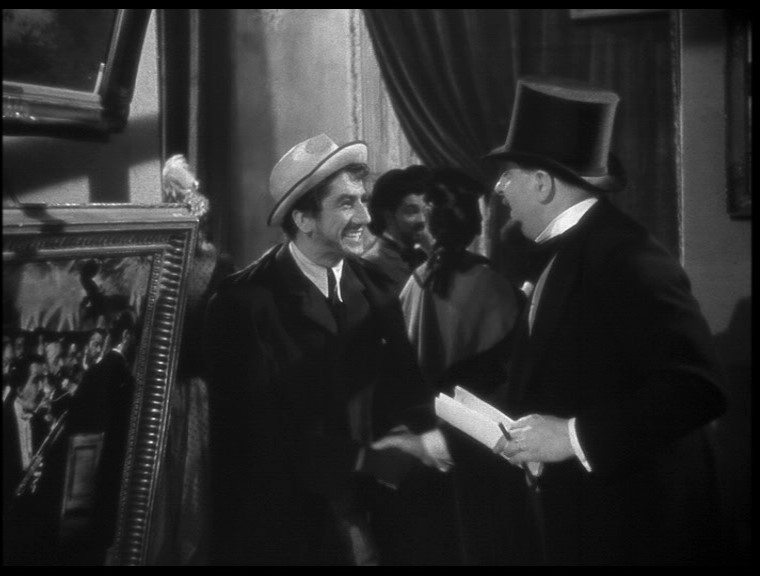
Le Masque (pictures above) tells the story of an old man who wears a mask so he can go to lavish balls, so he can approach and court young ladies who otherwise would have turned a blind eye to him. The majority of the story takes place in the decadent palace where the bal is taking place, the camera constantly moving through all three dimensions around the dancing characters, up and down the stairs, creating the space as it moves. The protagonist comes in inebriated and begins drunkenly dancing with a girl before he passes out from exhaustion, it's only when his mask is removed we see him for who he really is - before at his home we are filled in on his story by a doting wife. As striking as the camera movements are it's realy the costume and set design that stand out early on. Within the ball the dancers are constantly framed within windows and/or glass panes that surround the room and when we leave the ball we see a figure framed under the neck of a horse, the camera still [as it usually is in Le Plaisir] at a jaunty offset angle. There's a strange duality in the figure of the mask i feel; we pity him in many ways because his efforts will more often than not prove fruitless whilst we can sympathise slightly with his wife who seems to let this go on endlessly with little complaint. But as a metaphor, perhaps of the audience, putting on a mask to give the appearance of youth so one can fit into decadent surroundings - there seems something profound in this although i'm not sure exactly what.


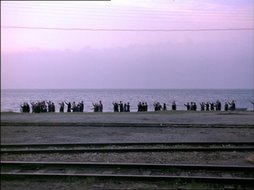
The bulk of the film is taken up by the story of what happens when a local brothel closes for a day. In La Maison Tellier we only ever see the brothel from the outside, a sly touch of style that allows for an amazing exterior shot that rises up around the outside of the building looking at everything inside through slits, window and door frames (pictured). When the house closes we see that the patrons, the local gentlemen can't get on without it - they try to sit down and have a conversation but the insults soon fly and disorder erupts. It is with a distinct sense of irony that it is the local whorehouse (seen as very respectable by the locals) which keeps the town running smoothly. Meanwhile the girls from the house go into the Normandy (although the original text is set elsewhere in France) countryside to see the first communion of the Madamme's niece. The hilly landscape fitting in perfectly with the director's style of offset camera angles and constant 3-dimensional panning and track. Within the church itself, ornately adorned with cherubs and other iconography (something criticised at the time although the actual church looks exactly like the set does) both the baroque nature of the film and the heavy emotional subtext come to the fore. During the ceremony, without reason, one of the girls - the outspoken Rosa, starts to weep which soon spreads until everyone in the church is crying. It becomes abundantly clear at this point the joy of the brothel, the smiles on the girls' faces as they invite the customers in is just a facade - and hence why we only see the outside of the building (literally only the facade) in the same way the patrons only see a front the girls put on. Following some celebratory drunkness the girls return to the house and everything goes pretty much back to the way it was before in town. There seems to be a moral tale at play here, but the film never judges the girls - they are merely women earning money from something they appear to enjoy; certainly their customers leave satisfied but nevertheless in the moment when they cry you realise that they are sad inside and that their job- to which they return, is stifling their emotional freedom. A tale of pleasures of the flesh and immorality, but not an overtly preachy or pious one, or indeed happy (despite appearances).


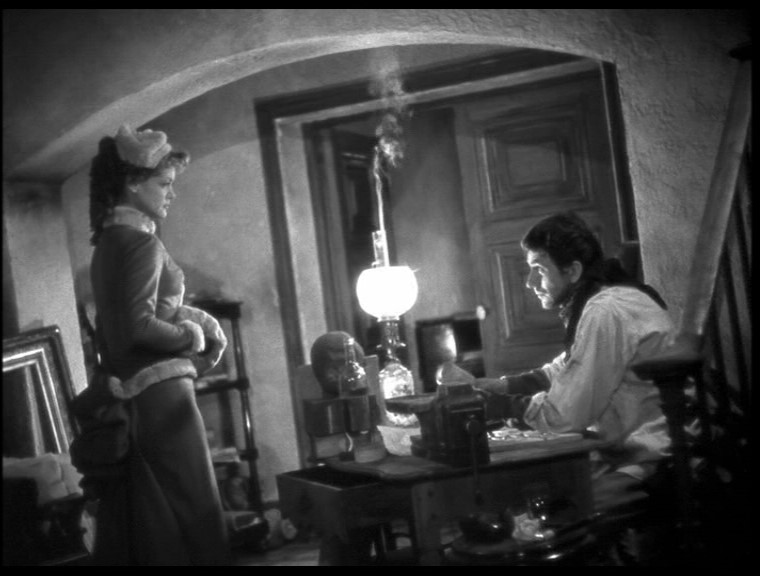
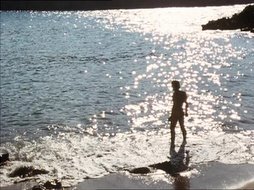
In the final tale an artist seeks happiness, joy and fulfilment through his muse - Le Modèle. In the most visually impresive of the three stories the opening shot tells the whole story of the protagonists' relationship without a single cut. Seeing his muse for the fiorst time the artist runs up some stairs after her, they disapear round a corner behind a wall and emerge seconds later hand-in-hand descending stairs opposite towards the camera. When the arguments start the camera follows one chase through the house, tracking through walls, following the character's pursuit before framing them in a window pane or door frame. In the final scene of the film, the most impressive technical shot of the film emerges: at the end of an argument the model turns out of frame, then walks up some stairs to throw herself out of the window. The camera, watching the argument in medium shot turns in time with the model becoming a 1st person P.O.V which then walks up the stairs, with the model's shadow on the wall in front of the camera, before opening the window and jumping out - the camera films the fall from the model's viewpoint the whole way down including crashing through the conservatory ceiling. Then in the final shot, going against every other shot in the film - no extraodinary detail in the set, no complex aperture framing or strange camera angles, no tracking either vertically or laterally - we get a glorioulsy simple, picturesque shot of people on an almost empty beach and thus, a sense of happiness is finally achieved. 8/10

Combustible Celluloid review

Thursday, 4 January 2007

Three Colours: Blue (1993) - Krzysztof Kieslowski


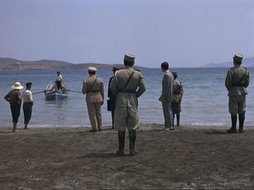
The first installment of Kieslowski's Trois Coleurs trilogy opens with a fatal car crash, and from there the drama rarely lets up. Julie (Binoche) surviving the car crash clams up completely. She ignores the advances of others shutting herself away into her own little world, shunning almost evry chance of attention or affection. She sells off all the property she owned with her now-deceased husband. But somewhere, somehow, love starts to creep back into her life - in between going to a peep show and discovering her husband had a mistress she finds something that allows some form of intimacy once again: music. Before he died her husband had been composing a unique piece to be played by 12 European symphonic orchestras simultaneously and it is this work, this pièce de résistance that provides some glimmer of hope in the bleakness of Julie's melancholic existence. Oh, she also gets a cat in to kill a family of mice too.

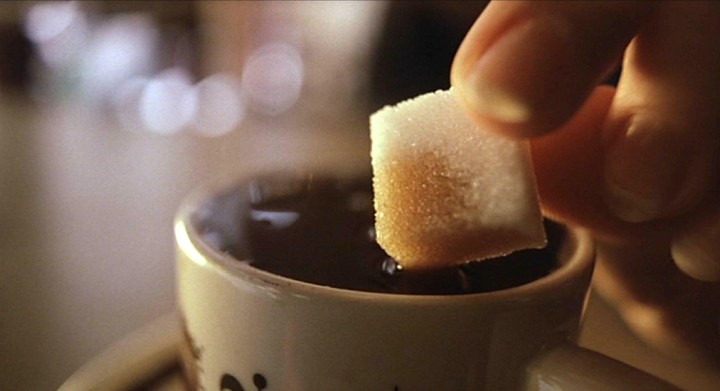
That's the story, but where to start with this films almost unrivalled brilliance? Slawomir Idziak's virtuosic cinematography - from framing to lens selction, from effects to camera movement provides the solid foundations of the masterpiece. The pinnacle comes perhaps early in the movie when we see one character reflected in their entirety in the pupil of Julie's eye - an astounding shot, but one that is matched throughout the film again and again in other ways (for instance a shot of a sugar cube soaking up coffee). The combination of wide deep-set shots with extreme close-ups in a way that feels perfectly natural for capturing our heroines perception of her world is simply breathtaking.

Then on top of all that aesthetic grandstanding you have Zbigniew Preisner. His Song For The Unification Of Europe surpasses many of the works of Morricone or Rota; the lyrical simplicity combining in intoxicating harmony with each new melodic chorus and crescendo. The weight, the sheer visceral power this aural assault adds to the image really cannot be overstated; even if you never see the film you should... indeed i say must by the soundtrack.

Finally there're the actors. Impassioned performances are given by all with Binoche never looking strained by the pressures on her role selling every tear, every glimmer of despair or hope with utmost honesty and conviction. Benoît Régent also deserves applauding for his turn as the long-suffering lover, rejected throughout by Julie yet he still puts his all into completing the unfinished composition - we believe his love, and that is all one can ask from an actor: to believe their character.

I could go on, the screenplay's deceptively simplicity masking a rare emotional depth the likes of which few European filmmakers could hope to achieve. The editing that produces in the film's climax an unforgettable symphony of sound and vision that will indelibly ingrain itself on your brain once you've seen it. The lighting never once misjudged. The sets and locations, minimal but often aptly mirroring and conveying what is going on inside the characters - it's not expressionist; it's just right.

But suffice to say i am thoroughly in love with this movie.

10/10

Mr Hulot's Holiday (1953) - Jacques Tati


Shot in his own purebrand style of visual comedy, Tati's quirky little film follows Mr Hulot on a beachside holiday, complete with noisy car and cane. He uspets the hotel residents with his music, he scares the tourists off the beach after an unfortunate incident involvinga wooden boat, and nearly destroys the town in the film's explosive finalé.

Charming and witty without becoming pretentious or flamboyent. Tati's modest sense of understated comedy hits the right note every time amongst it's real characters, gorgeous photography from the Jean Mousselle/Jacques Mercanton partnership and sublime musical accompaniments courtesy of Alain Romans.

Big thumbs up from me 7/10